
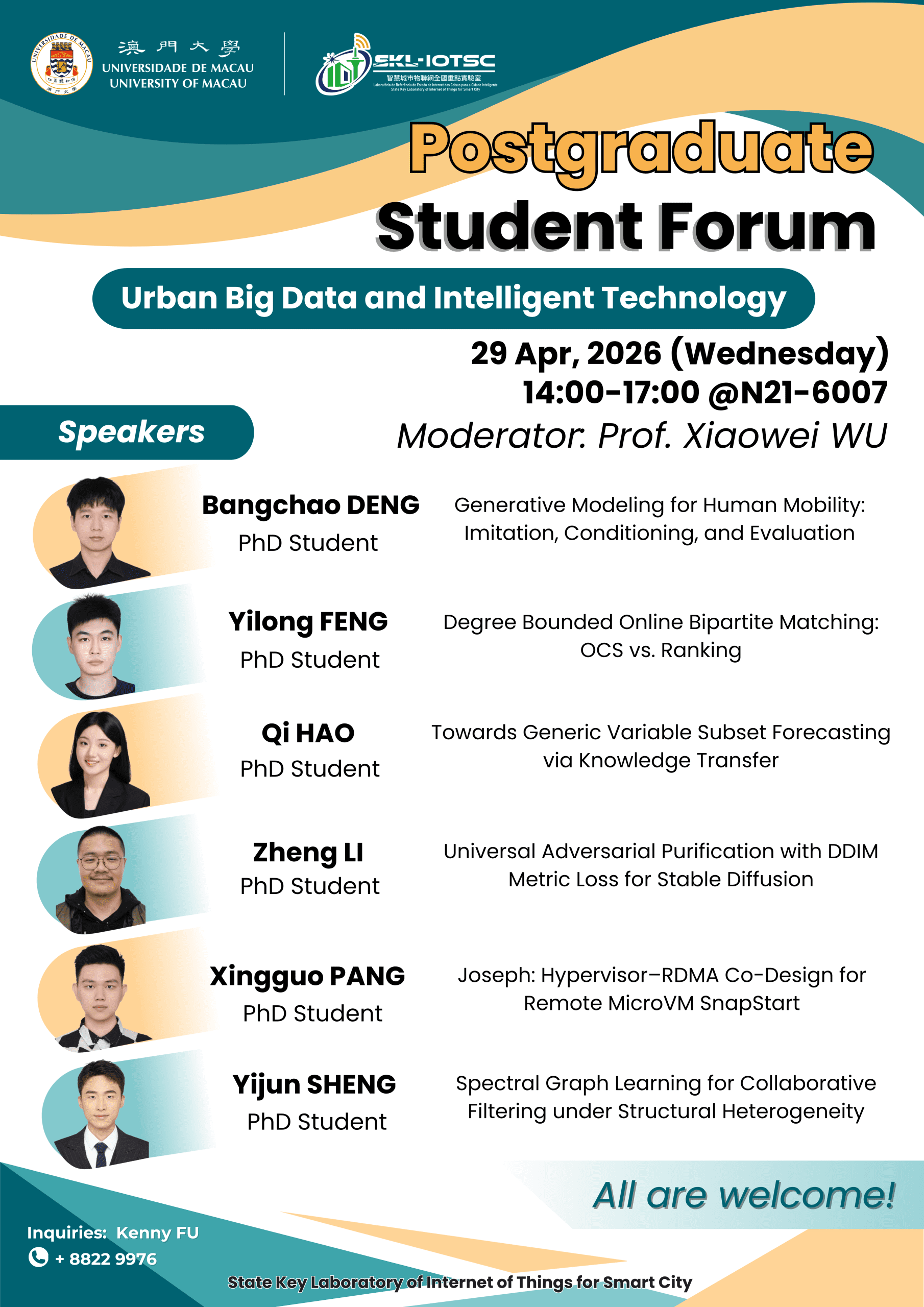
IOTSC Postgraduate Forum: Urban Big Data and Intelligent Technology
智慧城市物聯網研究生論壇: 城市大數據與智能技術
Dear Colleagues and Students,
The State Key Laboratory of Internet of Things for Smart City would like to invite you to join our “IOTSC Postgraduate Forum” on 29/04/2026 (Wednesday). The event aims to bring together postgraduate students from various disciplines to share their research, exchange ideas, and engage in meaningful discussions. We are pleased to invite six outstanding PhD students to give presentations related to Urban Big Data and Intelligent Technology.
IOTSC Postgraduate Forum: Urban Big Data and Intelligent Technology
Date: 29/04/2026 (Wednesday)
Time: 14:00-17:00
Language: English
Venue: N21-6007
Moderator: Prof. Xiaowei WU
| Presenters | Abstract |
| Bangchao Deng |
Generative Modeling for Human Mobility: Imitation, Conditioning, and Evaluation Generating high-fidelity synthetic human trajectories is foundational for applications ranging from urban planning and transportation management to epidemic simulation. However, modern generative models face two critical bottlenecks. First is the “Utility Gap” (the Datasaurus phenomenon), where synthetic data that mimics real-world statistical distributions fails to perform effectively in downstream tasks. Second is the lack of controllability, where models struggle to generate trajectories tailored to specific, fine-grained conditions or external contexts. |
| Yilong Feng |
Degree Bounded Online Bipartite Matching: OCS vs. Ranking We revisit the online bipartite matching problem on d-regular graphs, for which Cohen and Wajc (SODA 2018) proposed an algorithm with a competitive ratio of 1-2√(Hd/d) = 1-O(√(log d/d)) and showed that it is asymptotically near-optimal for d = ω(1). However, their ratio is meaningful only for sufficiently large d , e.g., the ratio is less than 1-1/e when d≤168 . In this work, we study the problem on (d, d)-bounded graphs (a slightly more general class of graphs than d-regular) and consider two classic algorithms for online matching problems: Ranking and Online Correlated Selection (OCS). We show that for every fixed d≥2, the competitive ratio of OCS is at least 0.835 and always higher than that of Ranking. When d→∞ , we show that OCS is at least 0.897 -competitive while Ranking is at most 0.816 -competitive. We also show some extensions of our results to 0.816-bounded graphs. |
| Qi Hao |
Towards Generic Variable Subset Forecasting via Knowledge Transfer Variable Subset Forecasting (VSF) is a challenging setting in multivariate time series forecasting, where only a subset of training-time variables is available during inference. Unlike conventional missing-data problems, VSF involves missing entire variables rather than isolated data points, which breaks down temporal patterns and cross-variable dependencies. Existing approaches face two key limitations. First, missing variable collapse occurs when the complete absence of certain variables makes correlation-based dependency modeling unreliable. Second, subset-agnostic generalization failure arises because models trained on a fixed variable set often do not generalize well to arbitrary subsets at test time. To address these challenges, I reconceptualize VSF as a knowledge transfer problem and explore three complementary directions: robust knowledge transfer via multi-level causal consistency, which uses causal structure as a stable source of knowledge; adaptive knowledge transfer through domain alignment, which transfers knowledge under variable mismatch and distribution shift; and task-oriented knowledge transfer with joint forecasting–imputation learning, which directly optimizes imputation for downstream forecasting performance. |
| Zheng Li |
Universal Adversarial Purification with DDIM Metric Loss for Stable Diffusion Stable Diffusion (SD) is highly vulnerable to adversarial noise, and existing defenses are inadequate for SD-specific attacks. We present Universal Diffusion Adversarial Purification (UDAP), a novel framework that effectively removes latent adversarial noise by minimizing the Denoising Diffusion Implicit Models (DDIM) metric loss during inversion. Additionally, we introduce a dynamic epoch adjustment strategy to significantly enhance purification efficiency. Extensive experiments validate UDAP’s strong robustness against diverse attacks. |
| Xingguo Pang |
Joseph: Hypervisor–RDMA Co-Design for Remote MicroVM SnapStart Modern serverless platforms such as AWS Lambda increasingly use MicroVM SnapStart to pair lightweight isolation with fast startup. However, restoring snapshots from RDMA-accessible remote memory to local DRAM induces layered copies and fault-driven stalls along the NIC → kernel → VMM → guest datapath, inflating latency and limiting system scalability under high concurrency. We present Joseph, a hypervisor–RDMA co-designed system for fast remote MicroVM SnapStart. Joseph builds a kernel-bypass NIC → VMM → guest restore path, eliminating host mediation between the RNIC and guest memory except for one-time KVM setup and protection. Its userspace VMM pager programs the RNIC to place data directly into guest pages, bypassing kernel buffers, avoiding user/kernel switches, and coalescing RDMA READs to amortize per-request latency. Joseph (i) enables direct RDMA access to remote snapshot pages, (ii) batches fault handling within the VMM pager and pipelines scatter–gather RDMA reads, and (iii) adds RNIC-offloaded guest memory registration for in-situ page mapping, enabling true zero-copy RDMA and lowering CPU contention. Implemented by extending Firecracker/KVM with new RDMA modules, Joseph achieves up to 77% (87%) lower SnapStart latency, 2× (3×) higher achievable concurrency, and 81% (56%) higher memory efficiency under high-concurrency workloads, compared to the state-of-the-art FaaSnap (TrEnv). |
| Yijun Sheng |
Spectral Graph Learning for Collaborative Filtering under Structural Heterogeneity Collaborative Filtering (CF) learns user preferences from historical interactions. Recent graph-based approaches model these interactions as bipartite graphs and perform spectral graph convolution for representation learning. However, most existing methods assume a homogeneous graph structure and enforce uniform spectral propagation requirements across all nodes, overlooking significant multi-level heterogeneity: local neighborhood patterns differ per node and global connectivity varies across datasets. This talk investigates graph-based CF from a spectral perspective and introduces novel approaches designed to address structural heterogeneity in recommendation. |
For enquiries: Tel: 8822 9976
Email: kennyfu@um.edu.mo
Best Regards,
State Key Laboratory of Internet of Things for Smart City