37 Years of Passing the Torch, Witnessing FST’s Growth and Transformation – Interview with Prof. Iu Vai Pan, Former Dean of FST
薪火相傳三十七載,見證澳大科技學院成長與蛻變 - 學院前院長姚偉彬教授專訪

 |
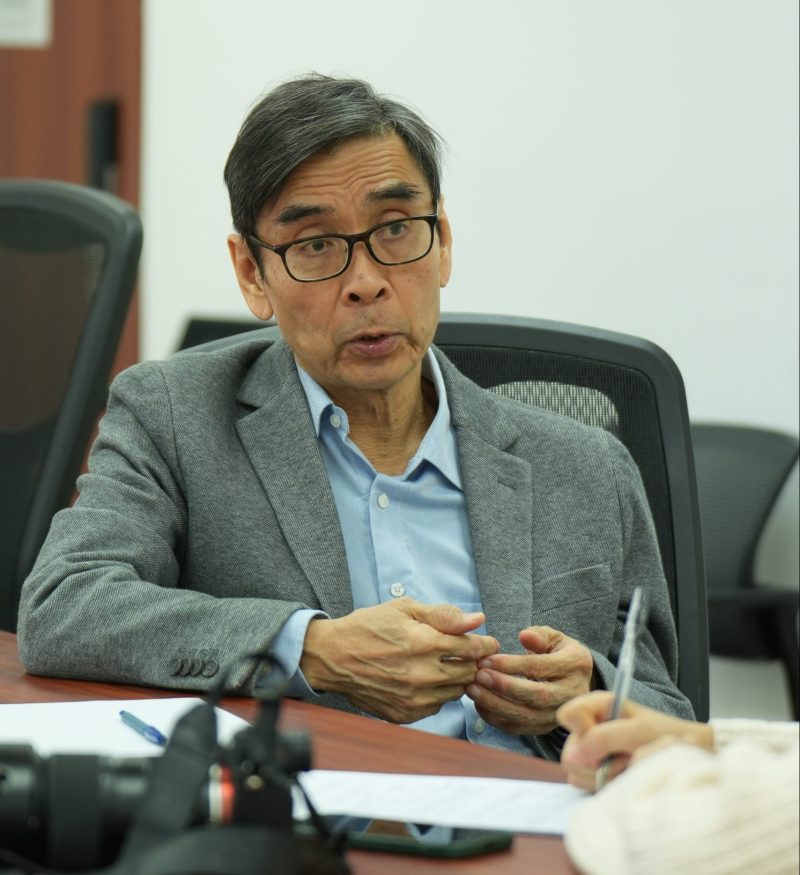 |
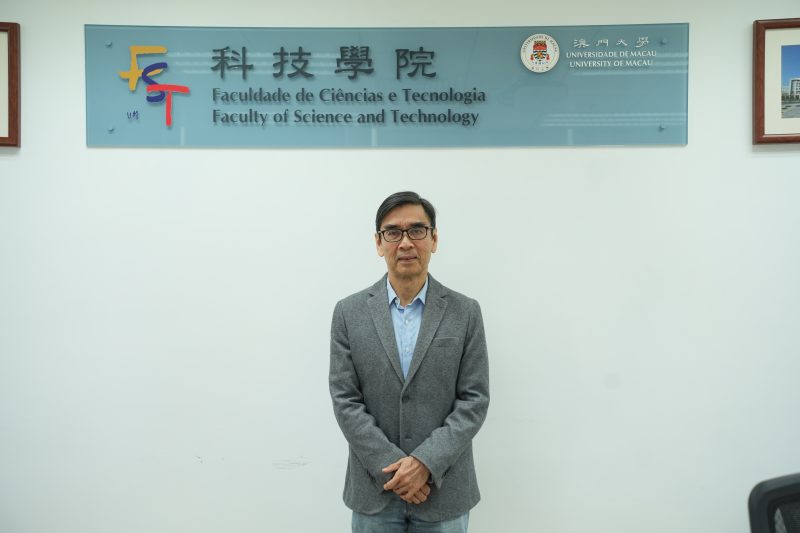
姚偉彬教授分享科技學院三十七載奮鬥歷程
Prof Iu Vai Pan shares the FST’s 37-year journey of dedication and progress
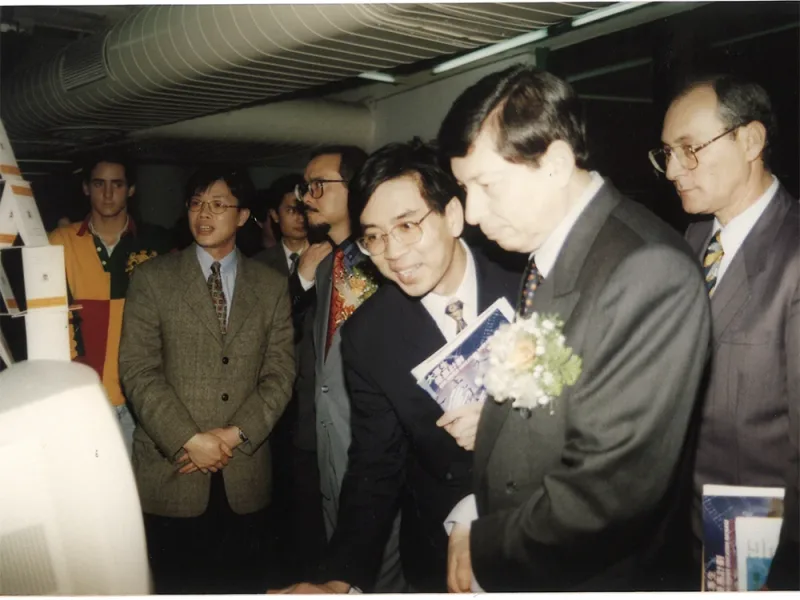
姚偉彬教授向時任行政、教育暨青年事務政務司黎祖智博士介紹澳大的科技成果
Prof Iu Vai Pan reports the university’s technological achievements to Dr Jorge Rangel, then secretary for public administration, education and youth of Macao
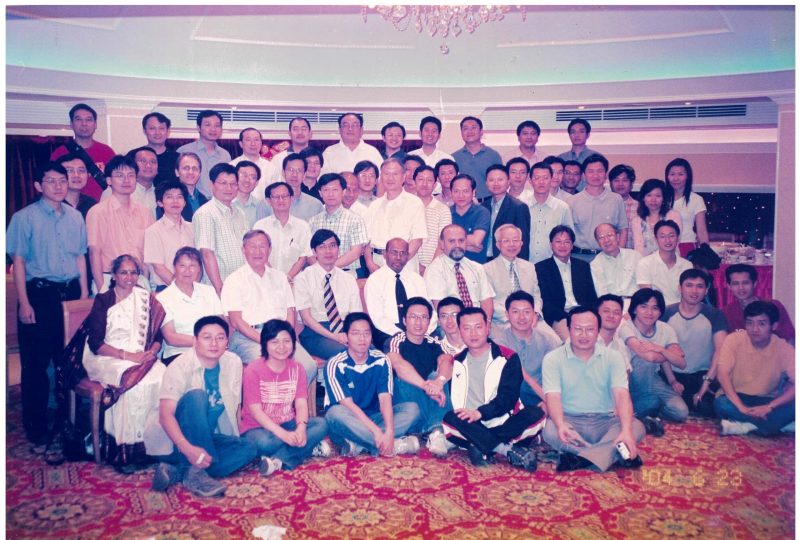
姚偉彬教授(第四排左四)與科技學院同事聚餐合照
Prof Iu Vai Pan (fourth from the left in the fourth row) in a group photo with the FST team at a dinner gathering
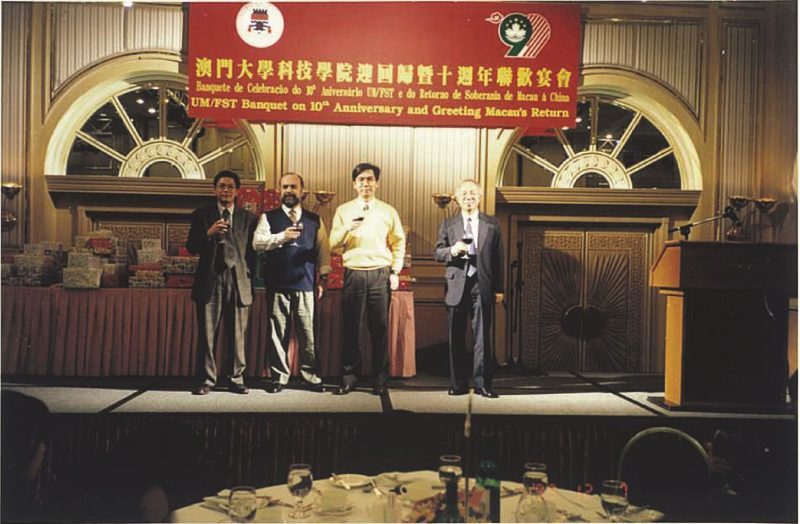
姚教授與一眾管理層慶祝科技學院十周年
Prof Iu celebrated the FST 10th Anniversary
Interview with Prof. Iu Vai Pan, Former Dean of FST
Rooted in Macao, Facing the World – Reflecting on 37 Years of Development
The Faculty of Science and Technology (FST) at the University of Macau (UM) is about to undergo a historic restructuring—starting from AY2026/2027, it will officially split into three independent faculties—the Faculty of Information Science and Technology, the Faculty of Engineering, and the Faculty of Science. At this pivotal moment of transition and renewal, we had the privilege of interviewing Prof. Iu Vai Pan, former dean of FST. As a key architect and witness to the faculty’s journey from its founding to maturity, Prof. Iu shared vivid recollections of FST’s grassroots beginnings and offered profound insights into its future and the broader development of higher education in Macao.
Starting from Scratch — A Steady Foundation
When FST was established in 1989, Prof. Iu joined as UM’s first Assistant Professor in Civil Engineering and served as the inaugural programme coordinator for civil engineering. In 1997, he became dean of FST, and two years later, he was appointed Rector of the University of Macau. Reflecting on his proudest achievements as dean, Prof. Iu displayed his characteristic pragmatism and humility—‘Everything started from zero when FST was first founded.’ He recalled that the faculty initially offered only undergraduate programmes; master’s programmes were gradually introduced as the first cohort of students progressed through their studies. This was an incremental process—hiring enough faculty to cover a full four-year curriculum in the first year was impossible, and laboratory facilities and equipment could not be built overnight.
Take civil engineering as an example—the original campus layout had no designated space for civil engineering labs. To address this urgent need, the faculty initially borrowed the ‘Civil Engineering Laboratory of Macao,’ jointly operated by the Macao SAR government, for student use. However, this was clearly not a sustainable solution. ‘We needed our own laboratories, but all the space had already been allocated,’ Prof. Iu admitted frankly. The team then adopted a resourceful approach—erecting makeshift tin-roof sheds on vacant plots and converting the ground floor of a parking structure at the far end of the old campus into laboratory space. Through such perseverance and ingenuity, FST gradually established comprehensive programmes in civil engineering, electrical and electronics engineering (now Electrical and Computer Engineering), software engineering, and mechanical engineering (now Electromechanical Engineering), along with seven core laboratories. ‘From FST’s founding in 1989 to around 1994–1996, our faculty, curriculum, and labs finally stabilized,’ Prof. Iu summarized. Since then, the faculty has continuously refined its programmes, achieving international accreditation—including recognition from the Hong Kong Institution of Engineers and signatory status under both the Washington Accord and Seoul Accord.
A Talent Incubator — Training One-Third of Macao’s Engineering Workforce
When asked about FST’s most significant contribution to Macao society over the decades, Prof. Iu answered without hesitation—‘Talent development.’ He estimates that ‘at least one-third of practicing engineers or individuals holding engineering qualifications in Macao today are graduates of FST.’ Behind this figure lies the mission of Macao’s flagship public university. ‘Our original goal was to train local engineering professionals. After Macao’s handover, that mission expanded to nurturing talent for the nation as well.’ This impact is evident not only in numbers but also in the quality and diverse career paths of its alumni.
Many outstanding graduates have returned to UM after completing advanced studies abroad, becoming pillars of the faculty itself—such as Prof. Lo Kin Ho (Electromechanical Engineering), Prof. Tam Kam Weng, Prof. Wong Man Chung, and Prof. Vai Mang I (Electrical and Computer Engineering), and Prof. Kou Kun Pang and Prof. Lam Chi Chiu (Civil Engineering). There are even ‘second-generation academics,’ like Prof. Kuok Sin Chi, who studied under Prof. Kou Kun Pang and now teaches the next generation, continuing the academic legacy.
Beyond academia, numerous graduates have pursued doctoral studies at top global institutions and now hold faculty positions internationally, demonstrating strong global competitiveness. Others remain rooted in Macao, taking leadership roles in engineering firms or serving in key government agencies—such as the Public Construction Bureau and the Environmental Protection Bureau—where FST alumni occupy critical posts. ‘Their success requires time to accumulate expertise,’ Prof. Iu said with pride. ‘Looking back over 37 years, talent cultivation remains our core achievement. These alumni continue to exert influence and will contribute to Macao society for years to come.’
Challenges and Turning Points — From Scarcity to Innovation
Yet the path of development was never smooth. Prof. Iu candidly acknowledged early struggles—securing lab space, funding equipment purchases, and attracting high-quality faculty. A turning point came in 1991, when the former University of East Asia was officially restructured into the public University of Macau, receiving direct government funding. ‘Our salary structure became aligned with the government’s, significantly improving our hiring conditions and enabling us to recruit internationally,’ he explained. This marked the beginning of a diverse and globally competitive faculty.
On research and innovation, Prof. Iu offered a pragmatic perspective. He believes the essence of engineering education in universities lies not merely in teaching students how to do something (How) or what to do (What), but in guiding them to understand why (Why). For FST, the deeper purpose of education is not necessarily to produce disruptive innovations directly, but to cultivate high-caliber talent with strong research capabilities. ‘Universities cannot compete head-to-head with global tech giants like Google or Microsoft in specialized R&D,’ he noted. ‘Our primary role is to serve as a “talent pipeline” for these companies and national research institutions.’ The process through which students deepen knowledge, develop technical skills, and improve efficiency during their studies is itself a vital form of capacity-building and innovation preparation. With the establishment of the Macao Science and Technology Development Fund in 2004, FST gained more stable research funding—supporting consumables, equipment upgrades, and graduate scholarships—thereby creating a virtuous cycle between talent development and scientific research.
Looking Ahead — Embracing the Greater Bay Area While Upholding Educational Values
Regarding the upcoming restructuring, Prof. Iu sees it as a natural evolution, especially in light of UM’s new campus in Hengqin, which unlocks greater academic and spatial potential. Given Macao’s limited local pool of STEM (Science, Technology, Engineering, and Mathematics) students, the new structure will enable the faculties to effectively expand recruitment and training across the Guangdong-Hong Kong-Macao Greater Bay Area, better aligning with national regional development strategies. He anticipates that the new faculties will launch cutting-edge programmes—such as artificial intelligence—and deepen collaborations with Greater Bay Area enterprises to create cross-border internships, joint R&D opportunities, and diverse career pathways, helping students truly integrate into the region’s dynamic growth.
When reflecting on the future of the faculties, Prof. Iu returned to his identity as an educator. He emphasized that while universities generate new knowledge, their fundamental mission is to transmit knowledge and nurture talent. ‘We must look beyond metrics like publication counts or research targets. What truly matters is whether students have genuinely learned and grown through the process of achieving those goals.’ In his view, university education should be a ‘refining process’—ensuring that students, regardless of their starting point, graduate with solid professional competence and well-rounded character. ‘Research and education must go hand in hand, but the latter is more fundamental. We must also strive to enhance students’ humanistic literacy and moral character.’
Prof. Iu’s reflections not only chronicle the remarkable journey of FST—from tin-roof labs built on empty lots to three new faculties poised for takeoff—but also offer profound contemplation on the essence of higher education in Macao. Despite continuous expansion in scale and ambition, one thing remains unchanged—the unwavering commitment of generations of UM educators to nurture talent for Macao and the country.
科技學院前院長姚偉彬教授訪談
紮根澳門,面向世界 – 回顧澳大科技學院三十七載發展之路
澳門大學科技學院即將迎來歷史性重組——自2026/2027學年起,將正式拆分為信息學院、工學院和理學院三個獨立學院。值此承前啟後之際,科技學院訪問了學院前院長姚偉彬教授。作為科技學院從創立到壯大的關鍵奠基者與見證者,姚教授娓娓道來科技學院從無到有的奮鬥歷程,並分享了他對學院未來澳門高等教育發展的深刻洞見。
從零起步:穩紮穩打的築基之路
1989年科技學院成立之初,姚偉彬教授便加入澳大,成為首位土木工程學助理教授,並擔任首任土木工程課程主任。1997年,他出任科技學院院長,兩年後升任澳門大學校長。回顧擔任院長期間最引以為傲的成就,他展現出一貫的務實與謙遜:「科技學院早期成立時,一切從零開始。」姚教授回憶道,學院最初僅有本科課程,隨著首屆學生逐年升級,碩士課程才逐步建立。這是一個循序漸進的過程,第一年無法聘請覆蓋四年課程的全部師資,實驗室的建設與設備配置也非一蹴而就。
以土木工程為例,舊校區在原始規劃中並未預留相關實驗空間。為解燃眉之急,學院初期曾借用由澳門政府參與運營的「澳門土木工程實驗室」供學生使用。然而,這終非長久之計。「我們需要自己的實驗室,但空間早已劃定,」姚教授坦言。於是,團隊開始「見縫插針」,在空地上搭建鐵皮屋,更將舊校區尾部停車場的底層改造為實驗室。正是憑藉這份堅持與巧思,學院逐步建立起涵蓋土木工程、電機電子(現為電機及電腦工程)、軟件工程、機械工程(現為機電工程)等領域的完整課程體系,並建成七個核心實驗室。姚教授總結道:「從1989年科技學院成立,到1994至1996年間,師資、課程、實驗室才基本穩定下來。」此後,學院持續優化其課程,邁向更高標準,及後更成功爭取多項國際工程教育認證,如獲香港工程師學會認證、華盛頓簽署國及首爾協定簽署國認可。
人才搖籃:為澳門培養三分之一的工程人才
談到科技學院多年來對澳門社會最顯著的貢獻,姚偉彬教授毫不猶豫地指出:「人才培養」。他估算:「如今澳門執業或具備工程師資格的人士中,至少有三分之一畢業於澳大科技學院。」這個數字背後,是學院作為澳門公立大學的使命擔當。「我們最初的目的就是在本地培養工程人員,回歸後,目標更擴展至為國家培養人才。」這份貢獻不僅體現在數量上,更體現於人才的質量與多元發展。許多優秀畢業生選擇學成歸來,反哺母校,成為學院的中堅力量:如機電工程系的羅健豪教授,電機與電腦工程系的譚錦榮教授、黃民聰教授、韋孟宇教授,以及土木工程系的高冠鵬教授、林智超教授等,更有「學術第三代」如郭善知教授——她曾是高冠鵬教授的學生,如今亦站上講台,延續學術薪火。
此外,眾多畢業生赴海外頂尖學府深造,並在國際高校任教,展現出強大的國際競爭力;更多人則紮根澳門,在工程企業擔任管理職,或進入政府部門服務,如澳門公共建設局、環境保護局要職,均由科技學院校友擔當。「他們的成功需要時間累積功力,」姚教授語帶自豪,「回顧學院三十七年,人才培養始終是最核心的成就。這些校友們正持續地發揮影響力、並將長期貢獻於澳門社會。」
挑戰與轉機:從資源匱乏走向科研創新
然而,學院的發展之路並非一帆風順,姚教授坦言,早期發展面臨諸多困難,包括爭取實驗空間、籌措購置儀器及吸引優質師資等。轉機出現在1991年,東亞大學正式改制為公立澳門大學,並獲得澳門政府直接撥款。「我們的薪酬體系與政府掛鉤,招聘條件大幅提升,開始有能力進行國際招聘。」隨後學院逐步建立起一支多元、國際化的優秀師資隊伍。
關於科研創新,姚教授分享了獨到而務實的見解。他認為大學工程教育的核心不在於僅教學生「如何做」(How)或「做什麼」(What),而在於引導他們思考「為什麼」(Why)。對於科技學院而言,教育的深層意義不僅在於直接產出顛覆性科研創新,更在於培養具備研究能力的高端人才。姚教授指出:「大學的條件無法與谷歌、微軟等全球商業巨頭在特定技術研發上直接競爭。我們的主要貢獻,是成為這些企業和社會研發機構的『人才源頭』。」學生在學期間的提升知識、發展技術、優化效率的過程,本身就是一種重要的能力儲備與創新鋪墊。而隨著澳門科技發展基金在2004年成立,學院獲得了更穩定的研究資源,用於支持耗材、儀器更新與研究生獎學金,從而形成「人才培養—科研發展」的良性循環。
展望未來:擁抱大灣區、堅守育人初心
對於科技學院學院重組,姚偉彬教授認為這順應了發展趨勢,尤其在橫琴新校區的背景下,將釋放更大的學術與空間潛能。面對澳門本地STEM(科學、技術、工程、數學)生源有限的現實,新架構有助於將招生與培養範圍有效拓展至粵港澳大灣區,更好服務國家區域發展戰略。他預期,新學院將有條件開設人工智能等前沿課程,並透過與大灣區企業的深度合作,為學生創造跨境實習、聯合研發與多元就業機會,幫助他們真正融入大灣區發展洪流。
談及對學院未來的發展的展望,姚偉彬教授回歸其教育家的本色,他認為大學的功能不僅是創造新知,根本在於傳承知識與培養人才。「我們不僅要看發表了多少論文、達成了哪些研究指標,更要關注在達成這些指標的過程中,學生是否真正學到了東西,能力是否獲得提升。」在他看來,大學教育應是一個「精煉的過程」,讓不同起點的學生,畢業時都能達到扎實的專業水準與綜合素質。「研究與育人應並重,而後者尤為根本。我們也應致力於提升學生的人文素養與人格品質。」
姚教授的分享,不僅是反映了科技學院的發展歷程,同時也是關於澳門高等教育本質的深刻思考。從一片空地上建起的鐵皮屋實驗室,到如今即將揚帆起航的三個嶄新學院,縱使學院不斷擴展規模與格局,不變的是一代代澳大人為澳門與國家培育人才的初心。