【IAS】Celebrating the 45th Anniversary of the University of Macau: Distinguished Guest Lecture: “Inconvertible Paper Currency in 14th-Century China: A Study of Currency Circuits” by Prof. Akinobu Kuroda (5 May 2026, Tuesday; 15:00 – 17:00)
【高研院】慶祝澳門大學45周年校慶 — 特邀嘉賓講座: “十四世紀中國的不兌現紙幣:從流通機制看全球首創之制”(2026年5月5日,星期二;15:00 - 17:00)

Dear Colleagues and Students,
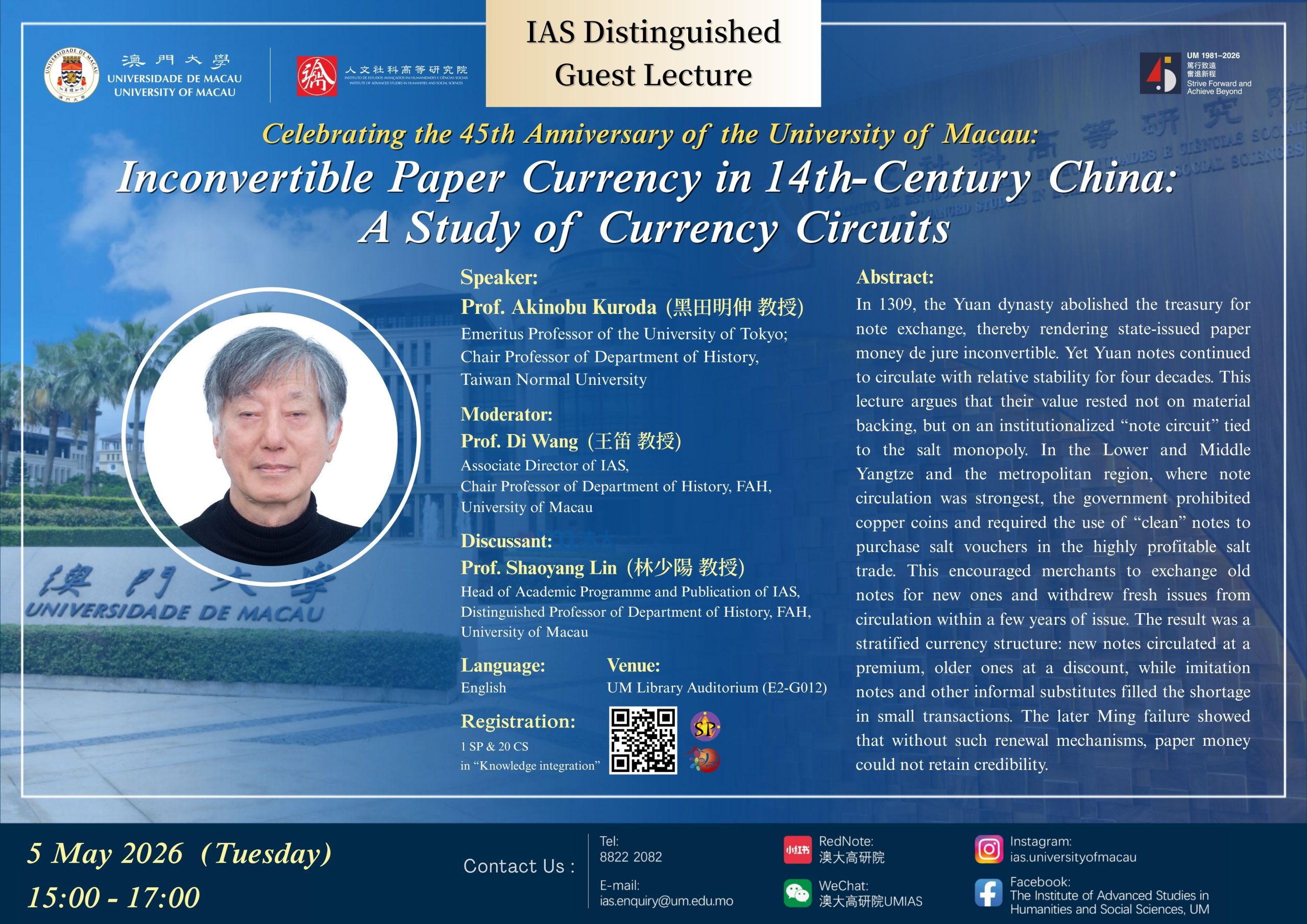
The Institute of Advanced Studies in Humanities and Social Sciences (IAS) warmly invites you to attend the upcoming IAS Distinguished Guest Lecture, titled “Inconvertible Paper Currency in 14th-Century China: A Study of Currency Circuits (十四世紀中國的不兌現紙幣:從流通機制看全球首創之制).” Please find the details below:
- Title: Inconvertible Paper Currency in 14th-Century China: A Study of Currency Circuits (十四世紀中國的不兌現紙幣:從流通機制看全球首創之制)
- Speaker: Prof. Akinobu Kuroda (黑田明伸 教授), Emeritus Professor of the University of Tokyo; Chair Professor of Department of History, Taiwan Normal University
- Moderator: Prof. Di Wang (王笛 教授), Associate Director of IAS, Chair Professor of Department of History, FAH, UM
- Discussant: Prof. Shaoyang Lin (林少陽 教授), Head of Academic Programme and Publication of IAS, Distinguished Professor of Department of History, FAH, UM
- Date: 5 May 2026 (Tuesday)
- Time: 15:00 – 17:00
- Venue: UM Library Auditorium (E2-G012)
- Language: English
- Registration: Click here
Abstract
In 1309, the Yuan dynasty abolished the treasury for note exchange, thereby rendering state-issued paper money de jure inconvertible. Yet Yuan notes continued to circulate with relative stability for four decades. This lecture argues that their value rested not on material backing, but on an institutionalized “note circuit” tied to the salt monopoly. In the Lower and Middle Yangtze and the metropolitan region, where note circulation was strongest, the government prohibited copper coins and required the use of “clean” notes to purchase salt vouchers in the highly profitable salt trade. This encouraged merchants to exchange old notes for new ones and withdrew fresh issues from circulation within a few years of issue. The result was a stratified currency structure: new notes circulated at a premium, older ones at a discount, while imitation notes and other informal substitutes filled the shortage in small transactions. The later Ming failure showed that without such renewal mechanisms, paper money could not retain credibility.
Biography
Akinobu Kuroda is Emeritus Professor at the University of Tokyo and Chair Professor of Department of History at Taiwan Normal University. His research encompasses comparative studies of monetary history in East Asia, India, Africa, and Europe, as well as specific investigations into China’s monetary history. The concept of complementarity among monies, which he developed, has exerted significant influence across studies in monetary theory, economic history, and anthropology. His publications include, ‘What is the Complementarity among Monies?: An Introductory Note,’ Financial History Review 15-1, 2008; ‘The Eurasian Silver Century, 1276-1359: Commensurability and Multiplicity,’ Journal of Global History 4-2, 2009 and A Global History of Money, Routledge, 2020.
We look forward to seeing you at this event! For more information about IAS, please visit the website at https://ias.um.edu.mo/. Should you have any questions, please do not hesitate to contact us at ias.programme@um.edu.mo.
Best regards,
The Institute of Advanced Studies in Humanities and Social Sciences
 Students who attend on-site will receive 1 SP and 20 CS for “Knowledge Integration” in the Whole Person Development Award.