News Express: UM develops AI platform to support TCM drug discovery for Alzheimer’s disease
新聞快訊:澳大成功構建人工智能平台 助力老人癡呆中藥研發
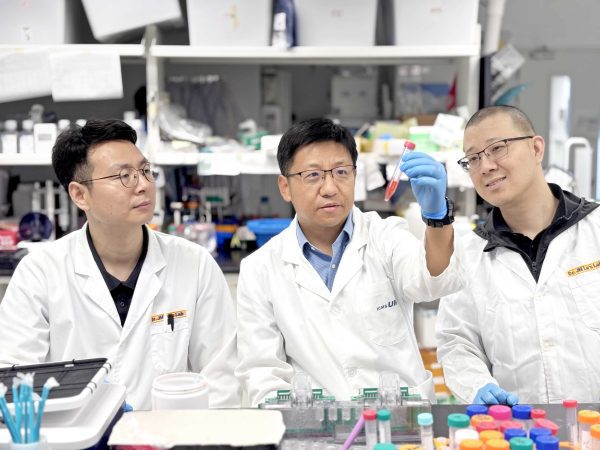
路嘉宏(中)、董雨(右)、莊旭旭(左)
(From left) Zhuang Xuxu, Lu Jiahong, Dong Yu
澳大成功構建人工智能平台 助力老人癡呆中藥研發
澳門大學中華醫藥研究院副院長路嘉宏帶領的研究團隊,與杭州德睿智藥科技有限公司及英國帝國理工學院合作,成功建立一個整合百萬級化合物信息與多個預測模塊的人工智能中藥及天然產物活性成分發現平台,並運用該平台進行虛擬篩選,結合跨物種實驗驗證,篩獲具備治療阿爾茨海默病(Alzheimer’s disease,AD)潛力的中藥小分子化合物。相關研究成果已刊登於國際頂級期刊《自然-生物醫學工程》(Nature Biomedical Engineering)。
中藥與天然產物歷來是藥物創新的重要源泉,然而其化學成分結構複雜、數目龐大,傳統篩選方法耗時費力,難以適應中藥現代化的發展需求。為突破這一技術瓶頸,研究團隊開發了人工智能驅動的新型中藥活性成分發現平台。該平台深度融合團隊前期研究基礎與前沿人工智能技術,借助先進算法與計算模型,可高效鎖定兼具神經保護、自噬調控活性及良好跨血腦屏障潛力的中藥活性成分。歷經兩次關鍵迭代(第一代成果已於2022年發表於《自然-生物醫學工程》),平台的天然產物及中藥化合物庫規模已擴充至百萬級別,篩選速度與準確度亦獲得顯著提升。目前,多個候選化合物已在疾病動物模型中展現優異效果,正處於進一步開發階段。
該人工智能平台已公開發佈(https://deepdrugdiscovery.mindrank.ai/),助力中藥的作用機制解析、加速創新藥物研發,為中藥的現代化與國際化提供技術支撐與平台工具。
全球阿爾茨海默病患者人數逾5000萬,然而,該領域的治療手段長期未能取得突破性進展。針對傳統靶點的AD藥物研發長期面臨困境,近年獲批上市的靶向澱粉樣蛋白抗體類藥物亦僅呈現有限的認知改善效果,且伴隨較為明顯的副作用。細胞自噬是細胞內部一種高度保守的“垃圾清理”機制,負責降解並回收受損的蛋白質與老化的胞器,對維持神經元穩態至關重要。大量研究顯示,AD患者腦內自噬功能受損,導致β類澱粉蛋白及過度磷酸化tau蛋白等毒性物質累積,加劇神經退行性病變。因此,靶向恢復或增強自噬功能,被視為對抗AD極具前景的新策略。該研究發現的候選中藥小分子,正是通過精準調控mTOR-非依賴的自噬途徑,促進毒性蛋白清除,從而延緩疾病進程,顯示出靶向自噬作為AD治療策略的臨床意義。
該研究通訊作者為路嘉宏及杭州德睿智藥科技有限公司首席執行官牛張明,共同第一作者為澳門大學博士後董雨及莊旭旭、杭州德睿智藥科技有限公司肖祥路及吳文凡。澳門大學健康科學學院副院長沈漢明、中華醫藥研究院副院長萬建波、教授蘇煥興、副教授余華及歐陽德方亦對研究給予重要支持。該研究獲澳門大學-何鴻燊博士醫療拓展基金會“揚帆追夢、創啟未來”資助計劃(檔案編號:SHMDF-OIRFS/2024/002)、國家自然科學基金面上項目(檔案編號:82271455)、澳門特別行政區科學技術發展基金(檔案編號:0040/2024/RIB1、0002/2025/NRP)以及澳門大學發展基金會(檔案編號:MYRG-GRG2024-00238-ICMS-UMDF、MYRG-GRG2023-00089-ICMS-UMDF)資助。全文可瀏覽:https://www.nature.com/articles/s41551-026-01667-x。
欲瀏覽官網版可登入以下連結:
https://www.um.edu.mo/zh-hant/news-and-press-releases/press-release/detail/63849/
UM develops AI platform to support TCM drug discovery for Alzheimer’s disease
A research team led by Lu Jiahong, deputy director of the Institute of Chinese Medical Sciences (ICMS) at the University of Macau (UM), in collaboration with Hangzhou MindRank AI Technology Co Ltd and Imperial College London in the UK, has developed an AI platform that integrates a million-compound library and multiple predictive modules for the discovery of bioactive ingredients in traditional Chinese medicine (TCM) and natural products. The team used the platform for virtual screening, followed by cross-species experimental validation, to identify small-molecule TCM compounds with therapeutic potential for Alzheimer’s disease (AD). The findings have been published in the top-tier international journal Nature Biomedical Engineering.
TCM and natural products have long been an important source of drug innovation. However, the chemical complexity and vast number of TCM constituents make traditional screening methods time-consuming and labour-intensive, hindering the modernisation of TCM. To overcome this bottleneck, the research team has developed an AI-driven discovery platform for TCM active ingredients. The platform seamlessly integrates the team’s previous research with cutting-edge AI technologies. Leveraging advanced algorithms and computational models, the platform can efficiently identify TCM ingredients with neuroprotective activity, autophagy-modulating properties, as well as favourable blood-brain barrier (BBB) permeability. The platform has undergone two key iterations (the results of the first generation were published in Nature Biomedical Engineering in 2022). The platform’s natural product and TCM compound library has grown to encompass millions of entries, and the speed and accuracy of screening have both been significantly improved. To date, several candidate compounds have already demonstrated promising effects in animal models of the disease and are currently undergoing further development.
The AI platform is now publicly available (https://deepdrugdiscovery.mindrank.ai/). Its aim is to facilitate the elucidation of TCM mechanisms, accelerate the discovery of innovative drugs, and provide technical support and a platform for the modernisation and internationalisation of TCM.
Over 50 million people worldwide suffer from AD. However, the field has long lacked major therapeutic breakthroughs. Drug development targeting traditional AD targets has faced persistent difficulties, and the amyloid-targeting antibody drugs approved in recent years offer only limited cognitive benefits and are associated with notable side effects. Autophagy, a highly conserved cellular ‘waste clearance’ mechanism that degrades and recycles damaged proteins and old organelles, is essential for maintaining neuronal homeostasis. Numerous studies have shown that autophagic dysfunction in the brains of AD patients leads to the accumulation of toxic substances, such as β-amyloid and hyperphosphorylated tau, which exacerbate neurodegeneration. Therefore, restoring or enhancing autophagy is regarded as a highly promising new strategy for treating AD. The candidate TCM small molecules identified in this study can precisely modulate an mTOR-independent autophagic pathway, promoting the clearance of toxic proteins and thereby slowing disease progression. This underscores the clinical relevance of targeting autophagy as a therapeutic approach for AD.
The corresponding authors of this study are Prof Lu and Niu Zhangming, CEO of Hangzhou MindRank AI Technology Co Ltd. Dong Yu and Zhuang Xuxu, postdoctoral fellows at UM, as well as Xiao Xianglu and Yu Wenfan of Hangzhou MindRank AI Technology Co Ltd, are the co-first authors. Other contributors to the research include: Shen Hanming, associate dean of FHS; Wan Jianbo, deputy director of ICMS; Su Huanxing, professor in ICMS; and Yu Hua and Ouyang Defang, associate professors in ICMS. The research was funded by the University of Macau-Dr. Stanley Ho Medical Development Foundation “Set Sail for New Horizons, Create the Future” Grant (Grant No.: SHMDF-OIRFS/2024/002), the General Program of the National Natural Science Foundation of China (Grant No.: 82271455), the Science and Technology Development Fund of the Macao SAR (Grant Nos.: 0040/2024/RIB1, 0002/2025/NRP), and the University of Macau Development Foundation (Grant Nos.: MYRG-GRG2024-00238-ICMS-UMDF, MYRG-GRG2023-00089-ICMS-UMDF). The full article can be accessed at: https://www.nature.com/articles/s41551-026-01667-x.
To read the news on UM’s official website, please visit the following link:
https://www.um.edu.mo/news-and-press-releases/press-release/detail/63849/