
News Express: UM Macao Humanities Forum discusses how language reflects the world
新聞快訊:澳大鏡海人文論壇談語言如何折射世界
澳大鏡海人文論壇談語言如何折射世界
The UM Macao Humanities Forum discusses how language reflects the world
澳大鏡海人文論壇談語言如何折射世界
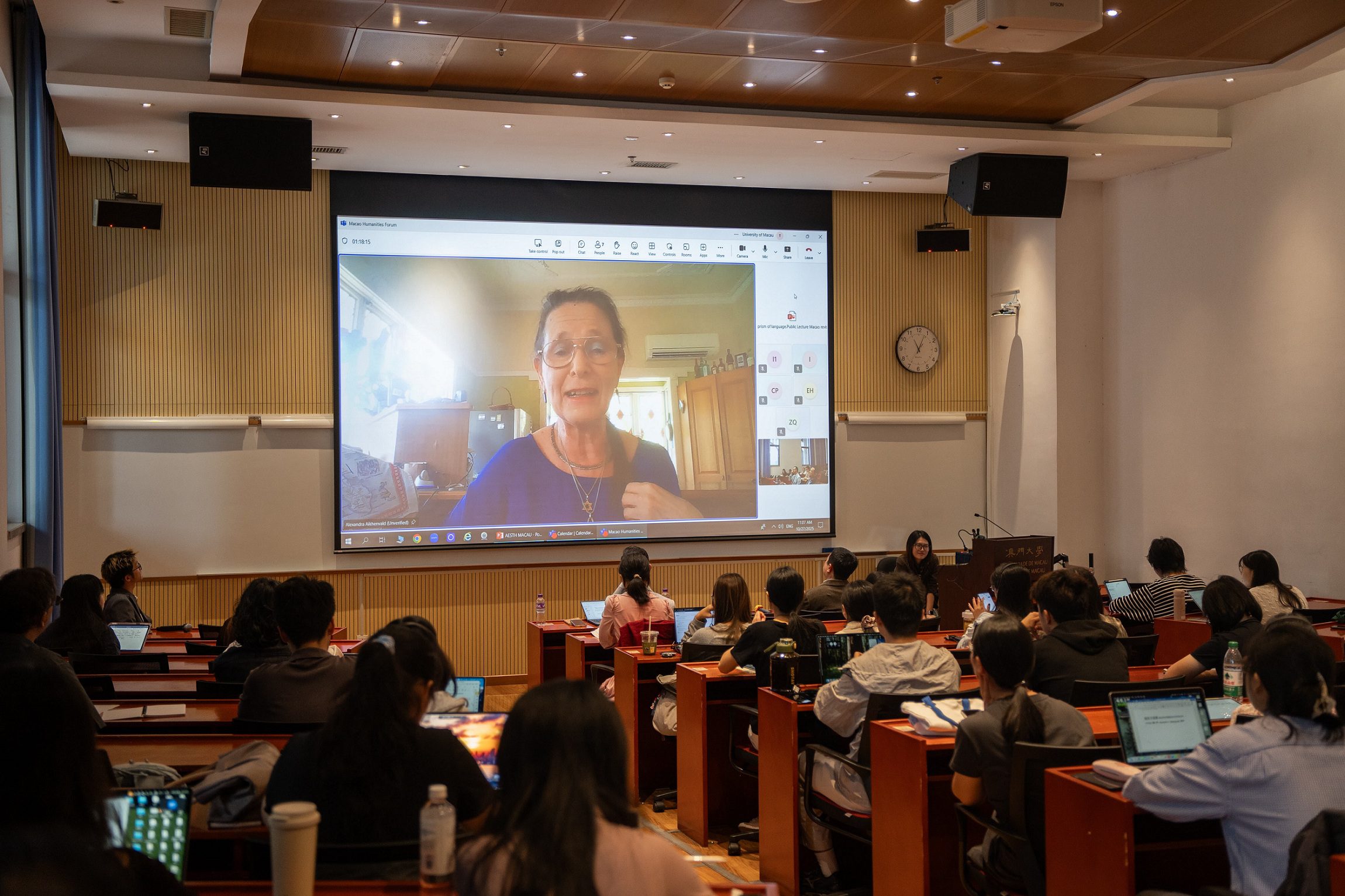
澳門大學人文學院舉辦“鏡海人文論壇”,由澳大利亞桂冠學者、中央昆士蘭大學資深研究教授Alexandra Y. Aikhenvald以“語言萬花筒:語法性別與量詞如何折射世界”為題發表演講,吸引眾多師生參與。
澳大人文學院助理院長鄺耀基致歡迎辭時指,是次論壇聚焦語言類型學,該學科致力於探索語言的結構多樣性及共性規律,幫助人們理解語言、認知、知識與文化的關係。澳大日文系主任楊文江介紹Aikhenvald的學術成就,表明其為國際知名的語言學家,在亞馬遜及巴布亞新幾內亞語言研究與語言類型學領域享有盛譽,主要研究方向包括示證範疇、量詞、語法性別、連動結構等;其代表作有Classifiers: A Typology of Noun Categorization Devices、How Gender Shapes the World等,均由牛津大學出版社出版;其開創性研究推動了語言類型學的發展,對語言學界影響深遠。
講座上,Aikhenvald闡釋了語法性別與量詞作為語言萬花筒的雙重功能。她介紹了語法性別與量詞的基礎概念、類型學範疇及功能。其中,語法性別通過形容詞、指示詞、修飾語及謂語的形態一致來體現,此種現象在葡萄牙語等語言中均有體現。她亦揭示了語法性別如何承載社會文化價值與偏見。例如,在部分南美洲語言中,博學女性被賦予陽性標記以示尊重;而英語中則存在用特定陰性辭彙指稱男性以表貶損之意的語言現象。她又聚焦量詞,講解該語言範疇如何映照特定社會的生活方式與文化偏好。例如,泰語中等級化量詞的消長反映了社會結構的變遷;漢語、哈里亞納語分別為馬和獨木舟設專用量詞,則反映了特定事物在相應社會中的文化地位。她還將量詞與語言演變、習得及磨蝕聯繫起來,指出語義寬泛的量詞多源於特定語義量詞,而兒童習得量詞遵循固定順序,所以在語言磨蝕過程中,習得較晚的量詞往往最先消失。
在問答環節,澳大師生與Aikhenvald就量詞系統的內部變化、語言與文化的動態互動等問題展開交流。Aikhenvald表示,量詞系統是動態的,語法性別與量詞的使用遠不止於語法功能,亦具有表徵社會地位、情感親疏、教育程度、權力關係等關鍵資訊的社會語用功能。
這是“鏡海人文論壇”2025/2026學年的第二講。論壇每學年都會邀請不同領域的知名人文學者,與澳門師生分享前沿研究成果。過往的論壇主題涵蓋文學、語言學、歷史、翻譯、藝術等多個領域。
欲瀏覽官網版可登入以下連結:
https://www.um.edu.mo/zh-hant/news-and-press-releases/campus-news/detail/62832/
UM Macao Humanities Forum discusses how language reflects the world
The Faculty of Arts and Humanities (FAH) of the University of Macau (UM) held the Macao Humanities Forum, where Alexandra Y. Aikhenvald, an Australian Laureate Fellow and professorial research fellow at the Jawun Research Institute of Central Queensland University, delivered a lecture titled ‘The world through the prism of language: what are gender and classifiers good for?’. The forum was well attended by students and faculty members.
Speaking at the event, Joaquim Kuong, assistant dean of FAH, highlighted the forum’s focus on linguistic typology, which explores structural diversity and commonalities among languages and deepens the understanding of the relationships between language, cognition, knowledge, and culture. Yang Wenjiang, head of the Department of Japanese of FAH, introduced Aikhenvald’s academic background and achievements, noting that she is an internationally renowned linguist with an outstanding reputation for her research on Amazonian and Papuan languages, as well as linguistic typology. Aikhenvald’s research areas include evidentiality, classifiers, gender, and serial verb constructions. Her representative works include Classifiers: A Typology of Noun Categorization Devices and How Gender Shapes the World, both of which are published by the Oxford University Press. Aikhenvald’s pioneering efforts have significantly advanced the development of linguistic typology and have had a profound impact on the linguistics community.
During the lecture, Aikhenvald introduced foundational concepts in gender and classifiers, delineating their typological categories and functional roles. She noted that grammatical gender involves morphological agreement on adjectives, demonstratives, modifiers, and predicates, a phenomenon observable in languages like Portuguese. She further explained that grammatical gender may encode sociocultural values and biases, as seen in some South American languages where erudite women are accorded masculine markers as a sign of respect, and conversely in English, where referring to men with feminine terms serves to demean them. Aikhenvald then turned to classifiers and explained how they reflect the lifestyles and culture of societies. For example, Thai once had a set of hierarchical classifiers, which have now evolved into polite generics as social structures loosened. The existence of unique classifiers often reflects the special status of culturally significant objects. For example, Chinese has the classifier pǐ for horses, while Tariana has a dedicated classifier for canoes. Aikhenvald further linked classifiers to language evolution, acquisition, and attrition. She noted that broad classifiers are often derived from specific ones. In language acquisition, children pick up classifiers sequentially, while in language dissolution, classifiers acquired later are often the first to disappear.
During the Q&A session, UM students and faculty members engaged in discussions with Aikhenvald on the variation of classifiers and the dynamic interplay between language and culture. Aikhenvald noted that classifiers and gender markers in language are not merely grammatical tools but potent indicators of social status, emotional proximity, education level, and power dynamics.
This was the second lecture of the Macao Humanities Forum for the 2025/2026 academic year. Each year, the forum invites distinguished scholars in different fields of the humanities to share their latest research findings with students and faculty members in Macao. Previous lectures of the forum have covered a wide range of topics, including literature, linguistics, history, translation, and arts.
To read the news on UM’s official website, please visit the following link:
https://www.um.edu.mo/news-and-press-releases/campus-news/detail/62832/