CCE, FBA-BRTC and HKU SPACE jointly organize “Beijing-Hong Kong-Macau Student Exchange Program” for students from Beijing University of Chemical Technology
澳大持續進修中心與工商管理學院商業研究及培訓中心、香港大學專業進修學院合作為北京化工大學學生舉辦京港澳學生交流活動項目
澳大持續進修中心與工商管理學院商業研究及培訓中心、香港大學專業進修學院合作為北京化工大學學生舉辦京港澳學生交流活動項目
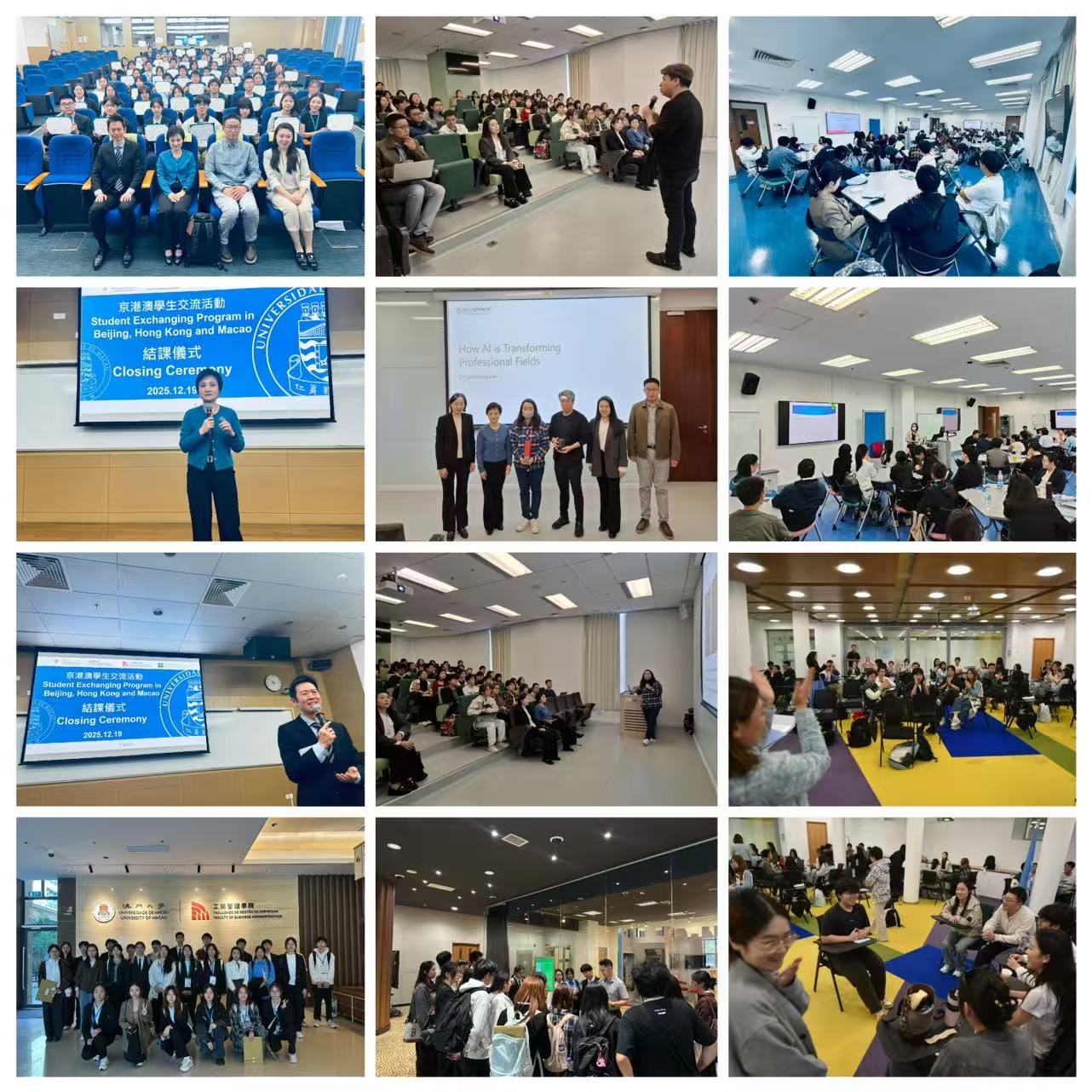
澳門大學持續進修中心於2025年12月15日至19日期間,與澳大工商管理學院商業研究及培訓中心、香港大學專業進修學院合作,為60位來自北京化工大學各學院的優秀學生在香港及澳門兩地成功舉辦“京港澳學生交流活動”。北京化工大學國際處副處長馮江鴻博士、材料科學與工程學院教授趙娜娜、教務處科員許亮及宏德書院輔導員郭藝偉隨團指導。
為期5天的培訓行程緊湊,由一系列專題講座及實地參訪組成,教學內容豐富,全程以英語授課。在港澳進行的課題緊貼時代前沿與區域發展,包括:“人工智能如何重塑你的專業:從跨學科視角看創新”、“在人工智能時代保持理性與向善”、“大灣區發展機遇”、“聯合國職業發展工作坊”以及“跨文化交流與全球視野”。學員們還前往香港大學校園、澳門大學工商管理學院以及聯合國大學澳門研究所等地進行參訪。
北京化工大學國際處副處長馮江鴻在結課儀式上表示,透過此次研學,同學們體驗到港澳兩地的風情面貌,以及有別於內地的教學風格,開闊了視野,收穫豐厚,未來有機會還會再來學習,並對兩校未來更多合作予以期許。澳門大學持續進修中心主任劉丁己教授則表示,歡迎北京化工大學的師生們之後再來澳大交流學習培訓。
北京化工大學創辦於1958年,原名北京化工學院,是新中國為“培養尖端科學技術所需求的高級化工人才”而創建的高校。學校是教育部直屬的全國重點大學,國家“211工程”和“985優勢學科創新平台”重點建設高校,並入選國家“雙一流”建設高校名單。目前共有十個學科位列ESI排名前1%(化學、材料科學、工程學、生物學與生物化學、生態/環境學、電腦科學、農業科學、地球科學、物理學、藥理學與毒理學),其中化學、材料科學、工程學居ESI排名前1‰。
本次培訓活動澳門大學持續進修中心再次與香港大學專業進修學院合作,透過跨城市學術交流,持續推動京港澳大灣區聯動的持續進修教育合作新模式的發展,進一步加強了內地與港澳高校在人才培養方面的深度合作。
CCE, FBA-BRTC and HKU SPACE jointly organize “Student Exchanging Programme in Beijing, Hong Kong and Macao” for students from Beijing University of Chemical Technology
The Centre for Continuing Education (CCE) of the University of Macau (UM), in collaboration with the Centre for Business Research and Training (BRTC) of the Faculty of Business Administration (FBA) and the School of Professional and Continuing Education of the University of Hong Kong (HKU SPACE), successfully held the “Beijing-Hong Kong-Macao Student Exchange Activity” for 60 outstanding students from various colleges of Beijing University of Chemical Technology (BUCT) in Hong Kong and Macao from December 15 to 19, 2025. The delegation was guided by Dr. Feng Jianghong, Deputy Director of the International Office at BUCT; Prof. Zhao Nana from the College of Materials Science and Engineering; Xu Liang, staff member of the Academic Affairs Office; and Guo Yiwei, Counselor of Hongde College.
The five-day training program was intensive and comprised a series of thematic lectures and field visits. The curriculum was rich in content and conducted entirely in English. The topics covered in Hong Kong and Macao were closely aligned with the frontiers of the era and regional development, including “How AI Reshapes Your Profession: Innovation from an Interdisciplinary Perspective”, “Staying Rational and Benevolent in the Age of AI”, “Development Opportunities in the Greater Bay Area”, “UN Career Workshop”, and “Cross-cultural Communication and Global Vision”. Students also visited the campus of the University of Hong Kong (HKU), the Faculty of Business Administration at UM, and the United Nations University Institute in Macau (UNU Macau).
At the closing ceremony, Dr. Feng Jianghong, Deputy Director of the International Office at BUCT, stated that through this study tour, students experienced the local culture and atmosphere of Hong Kong and Macao, as well as teaching styles different from those in the mainland. She noted that the students broadened their horizons and gained significant insights, and she expressed hope for future opportunities to return for further learning and for more cooperation between the two universities. Prof. Matthew Ting-chi Liu, Director of UM CCE, welcomed the faculty and students of BUCT to visit UM again for exchange and training.
Beijing University of Chemical Technology, established in 1958 and originally named Beijing Institute of Chemical Technology, is a university founded in New China to “cultivate advanced chemical talents required for cutting-edge science and technology”. It is a national key university directly under the Ministry of Education, a key university of the national “Project 211” and the “985 Project Innovation Platform”, and is listed in the national “Double First-Class” initiative. Currently, ten disciplines are ranked in the top 1% of ESI (Chemistry, Materials Science, Engineering, Biology & Biochemistry, Environment/Ecology, Computer Science, Agricultural Sciences, Geosciences, Physics, and Pharmacology & Toxicology), with Chemistry, Materials Science, and Engineering ranking in the top 1‰.
For this training activity, UM CCE once again collaborated with HKU SPACE. Through cross-city academic exchange, the program continues to promote the development of a new model of continuing education cooperation linking Beijing, Hong Kong, and the Macao Greater Bay Area, further strengthening the in-depth cooperation in talent cultivation between universities in Chinese mainland, Hong Kong, and Macao.