
News Express: UM research reveals new mechanism of immune evasion in triple-negative breast cancer
新聞快訊:澳大團隊揭示三陰性乳腺癌免疫逃逸新機制
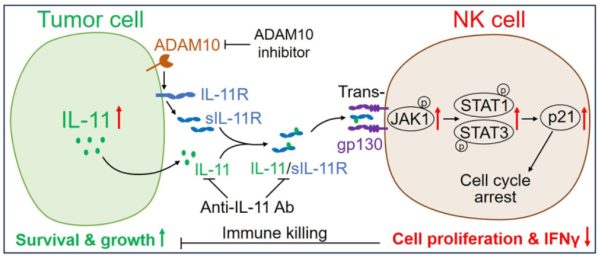
TNBC細胞分泌的IL-11與受體結合後啟動信號通路從而抑制NK細胞功能,促使腫瘤免疫逃逸
TNBC cells use IL-11 to suppress immune cells and escape immune attack
澳大團隊揭示三陰性乳腺癌免疫逃逸新機制
澳門大學健康科學學院教授羅茜帶領的研究團隊成功揭示三陰性乳腺癌(TNBC)躲避免疫系統攻擊的新機制。研究發現,這種TNBC免疫逃逸新機制,即TNBC細胞通過白細胞介素-11(IL-11)介導的反式信號通路抵抗自然殺傷(NK)細胞的殺傷作用。該研究成果為提高基於NK細胞的免疫療效提供了新思路,已發表於國際知名期刊《先進科學》(Advanced Science)。
TNBC是惡性程度最高的乳腺癌亞型。由於缺乏明確的治療靶點,患者從激素治療或抗HER2靶向治療中獲益甚微,化療成為主要治療選擇。此外,TNBC具有高度侵襲性,轉移風險高,且常對化療藥物產生耐藥性。儘管近年來基於NK細胞的免疫療法因其能夠直接識別並殺傷腫瘤細胞而備受關注並取得了顯著進展,但TNBC通常利用多種途徑逃逸 NK 細胞的殺傷。澳大研究團隊的研究揭示了 TNBC 抵抗 NK 細胞殺傷的新機制。
該研究發現,部分侵襲性TNBC細胞通過分泌IL-11來抵抗NK細胞的殺傷作用。IL-11與其自身脫落的可溶性受體(sIL-11R)結合,形成“IL-11/sIL-11R”複合物,該複合物隨後與NK細胞表面的gp130受體結合,啟動細胞內JAK1/STAT1/3信號通路。該啟動作用上調p21的表達,導致NK細胞週期阻滯,進而降低了幹擾素-γ(IFN-γ)的產生和分泌,從而減弱了NK細胞的殺傷作用,使得TNBC細胞對NK細胞具有抵抗力。
為了驗證相關發現,研究團隊使用抑制劑阻斷IL-11或sIL-11R,成功恢復了NK細胞的增殖。更重要的是,臨床樣本分析證實,TNBC患者腫瘤組織中IL-11表達顯著升高,且與浸潤到腫瘤組織中的NK細胞數量呈顯著負相關。這一發現為IL-11在幫助TNBC細胞逃避免疫監視方面發揮關鍵作用,提供了強而有力的臨床證據。
另外,該研究還揭示了TNBC細胞利用IL-11介導的反式信號通路抵抗NK細胞的免疫攻擊的分子機制。該研究結果為精準開發IL-11靶向藥物奠定了基礎,並為優化基於 NK 細胞的免疫療法治療 TNBC 患者提供了新策略。
該研究通訊作者為羅茜,第一作者為澳大健康科學學院博士後楊紅梅,博士生賈皓、吳仁飛、童海波和陳麗萍亦參與相關研究。該研究獲澳門大學(檔案編號:2022-00025-FHS)、澳門特別行政區科學技術發展基金(檔案編號: 068/2017/A2、0147/2020/A3、044/2021/APD、0004/2021/AKP)和國家教育部澳門大學精準腫瘤學前沿科學中心(檔案編號:SP2023-00001-FSCPO)資助。全文可瀏覽: https://doi.org/10.1002/advs.202515772。
欲瀏覽官網版可登入以下連結:
https://www.um.edu.mo/zh-hant/news-and-press-releases/campus-news/detail/63203/
UM research reveals new mechanism of immune evasion in triple-negative breast cancer
A research team led by Kathy Qian Luo, professor in the Faculty of Health Sciences (FHS) at the University of Macau (UM), has uncovered a new mechanism that enables triple-negative breast cancer (TNBC) to evade attacks from the immune system. The study shows that TNBC cells resist natural killer (NK) cell-mediated killing through an interleukin-11 (IL-11)-mediated trans-signalling pathway. This discovery provides new insights into strategies for enhancing the efficacy of NK cell-based immunotherapy. The findings have been published in the leading international journal Advanced Science.
TNBC is the most aggressive subtype of breast cancer. Due to the lack of well-defined therapeutic targets, patients with TNBC receive little benefit from hormone therapy or anti-HER2 targeted treatments, leaving chemotherapy as the primary option for treatment. Furthermore, TNBC is highly invasive, carries a high risk of metastasis, and frequently develops drug resistance. Although NK cell-based immunotherapy has gained significant attention and made considerable progress in recent years due to the cells’ ability to directly recognise and kill tumour cells, TNBC often employs various pathways to evade NK cell-mediated attacks. The UM research team has elucidated the mechanisms through which TNBC cells resist NK cell-mediated killing.
The study found that some aggressive TNBC cells acquire resistance to NK cell-mediated killing by secreting IL-11, which binds to its own shed soluble receptor (sIL-11R) to form an ‘IL-11/sIL-11R’ complex. This complex then binds to the gp130 receptor on the surface of NK cells to activate the intracellular JAK1/STAT1/3 signalling pathway. This activation upregulates p21 expression, leading to cell cycle arrest in NK cells. The reduction of NK cells proliferation subsequently decreases the production and secretion of interferon-gamma (IFN-γ), thereby weakening NK cell cytotoxicity and enabling TNBC cells to evade immune destruction.
To validate these findings, the team used inhibitors to block either IL-11 or sIL-11R, successfully restoring the proliferation of NK cells. More importantly, analysis of clinical samples confirmed that IL-11 expression is significantly elevated in tumour tissues from TNBC patients and shows a significant negative correlation with the number of NK cells infiltrated into the tumour tissues. These results provide strong clinical evidence supporting the critical role of IL-11 in helping TNBC cells evade immune surveillance.
Moreover, the study reveals the molecular mechanism through which TNBC cells utilise IL-11-mediated trans-signalling pathway to resist NK cell-mediated immune attack. The findings pave the way for the precise development of IL-11-targeted drugs and offer novel strategies for optimising NK cell-based immunotherapy in treating patients with TNBC.
Kathy Qian Luo is the corresponding author of the study, with Yang Hongmei, a postdoctoral fellow in UM FHS, as the first author. FHS doctoral students Jia Hao, Wu Renfei, Tong Haibo, and Chen Liping also contributed to the research. The study was funded by UM (File No: 2022-00025-FHS), the Science and Technology Development Fund of the Macao SAR (File Nos: 068/2017/A2, 0147/2020/A3, 044/2021/APD, 0004/2021/AKP), and the Ministry of Education Frontiers Science Center for Precision Oncology (File No: SP2023-00001-FSCPO). The full version of the research article is available at: https://doi.org/10.1002/advs.202515772.
To read the news on UM’s official website, please visit the following link:
https://www.um.edu.mo/news-and-press-releases/campus-news/detail/63203/