
News Express: UM research discovers way to boost production of cardiomyocytes
新聞快訊:澳大研究發現大幅提升人類心肌細胞產量方法
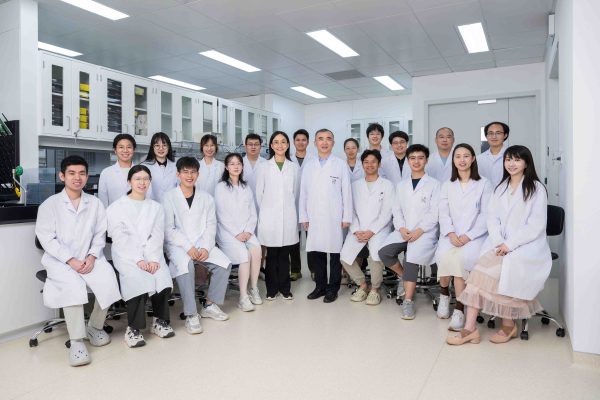
陳國凱研究團隊
Chen Guokai and his research team
澳大研究發現大幅提升人類心肌細胞產量方法
澳門大學健康科學學院教授陳國凱及副教授邵寧一的研究團隊與該學院生物成像及幹細胞核心實驗中心合作,建立體外心肌分化新方法。該研究揭示,在培養細胞的關鍵階段進行傳代操作,即把細胞分到新的培養皿裡再重新培養,能促使幹細胞變成心肌細胞,且產量翻近 10 倍;而且這些心肌細胞還能一直增殖、更快長成成熟細胞,不管是研發相關藥物,還是未來用細胞治病,都可用這方法高效、穩定地造出心肌細胞。相關研究已發表於國際知名期刊《國際生物科學期刊》(International Journal of Biological Sciences)。
體外誘導生成的心肌細胞可用於心臟病治療、藥物篩查、毒性檢測,是科學研究和臨床治療的寶貴資源。如何在短時間內穩定地製備出大量高品質心肌細胞,是產業化與再生醫學的瓶頸。傳統單層分化多採用靜止培養模式,細胞在整個分化過程中始終維持與基質的黏附,生長在無法延展的培養皿表面,研究人員通過化學藥物對高度保守的細胞間訊號傳遞系統WNT訊號通路進行時序調節以實現心肌誘導。在該模式下,細胞生長環境擁擠、營養與空間不足,早期即停止增殖。澳大研究團隊提出一個簡單問題:若在分化中期進行細胞傳代,短暫重置細胞-基質貼附,會發生什麼?
事實證明,在分化的正確時間節點對中胚層前體細胞進行一次傳代(解離並重新鋪板),不但可以維持細胞持續增殖、保持良好的細胞狀態,甚至可在不加入訊號通路化學抑制劑的情況下,引導細胞定向分化為心肌譜系。也就是說,傳代這一物理操作本身,即足以改變細胞命運。
這一出乎意料的結果促使團隊展開了進一步研究,探索細胞-基質貼附對細胞的各方面影響。實驗結果表明,細胞貼附的重塑可以調節整合素(integrin)訊號。整合素(integrin)是一類跨膜受體,負責把細胞外基質(ECM)訊號傳入細胞內。通過這條通路,細胞傳代可達到激活AMPK、抑制PI3K/AKT訊號通路的效果,而這兩者均在心肌分化中起到重要作用。在靜態培養環境中以化學藥物調節整合素通路,亦可模擬細胞傳代的效應。
研究團隊隨即對這一全新心肌誘導方法進行了優化。經驗證,該方法在多種人類多能幹細胞系中均有效,適用於各種細胞培養基質,且與WNT抑制劑可產生協同。通過傳代誘導生成的心肌細胞可在分化同時維持持續增殖,且心肌細胞成熟速度與傳統的靜態平台相比顯著提升。該方法簡單、可放量、易標準化,7至10天即可獲得高純度心肌細胞,且產量與一致性顯著提升。傳代時可以按需要採用各種比例,在較高稀釋比例(如1:20)下,產量較傳統靜態培養可提升達約10倍。
團隊指出,通過重塑細胞貼附改變細胞命運,是幹細胞定向分化領域的全新思路。除了心肌分化之外,在其他分化體系中於“關鍵時窗”調控細胞貼附,亦完全可能提升目標細胞產生效率,獲得以往難以成功分化的細胞類型,或提高其他種類細胞的產率與品質以用於研究與治療。
該研究通訊作者為陳國凱與邵寧一;共同第一作者為澳大生物成像及幹細胞核心實驗中心營運經理劉蔚蔚和健康科學學院博士生劉楚羽。該學院博士生王倩及南京艾爾普再生醫學科技有限公司成員亦對研究作出貢獻。該項目由澳門大學(檔案編號:MYRG‑GRG2023‑00137‑FHS‑UMDF、MYRG‑GRG2024‑00192‑FHS)、澳門特別行政區科學技術發展基金(檔案編號 :0010/2023/AKP、0059/2019/A1、0123/2019/A3、0085/2023/AMJ、0002/2023/RIB1、0073/2023/ITP2)、南京市科學技術局(檔案編號 :2023A05050)、國家重點研發計劃(檔案編號 :2022YFA1105000)資助。全文可瀏覽:https://www.ijbs.com/v21p6542.htm。
欲瀏覽官網版可登入以下連結:
https://www.um.edu.mo/zh-hant/news-and-press-releases/campus-news/detail/63262/
UM research discovers way to boost production of cardiomyocytes
A research team led by Chen Guokai, professor in the Faculty of Health Sciences (FHS) at the University of Macau (UM), and Shao Ningyi, associate professor also in FHS, in collaboration with the Biological Imaging and Stem Cell Core in FHS, has developed a new method for producing heart muscle cells (cardiomyocytes). The study reveals that briefly remodelling cell adhesion—by simply dissociating and replating cells at a critical stage of differentiation—can significantly promote the differentiation of human pluripotent stem cells into cardiomyocytes. This simple passaging step increases cardiomyocyte yield by up to tenfold, maintains continuous cell proliferation, and accelerates maturation. It provides a highly efficient and robust approach for producing cardiomyocytes for drug development and future cell therapies. The study has been published in the leading international journal International Journal of Biological Sciences.
As valuable resources for scientific research and clinical applications, cardiomyocytes generated through in vitro differentiation can be used for cardiac disease treatment, drug screening, and toxicity testing. A key challenge in regenerative medicine and industrial-scale production is the reliable generation of large quantities of high-quality cardiomyocytes within a short period of time. Traditional monolayer differentiation methods rely on static culture conditions in which cells remain adhered to the cell culture matrix and grow on the limited surface of culture plates. Researchers typically modulate the WNT signalling pathway with chemical inducers and inhibitors to drive cardiac differentiation. However, under static conditions, cell cultures quickly become overcrowded, with insufficient nutrients and space, leading to early cell-cycle arrest and reduced proliferation. This prompted the UM team to ask a simple question: what would happen if cells were passaged midway through the differentiation process to transiently remodel cell adhesion?
The study showed that passaging mesodermal progenitor cells at the appropriate time point not only sustained their proliferation and maintained the cells in a healthy state, but also induced cardiac differentiation even without the use of pathway modulators. In other words, the physical action of passaging alone was sufficient to alter cell fate.
This unexpected result motivated the team to further investigate how remodelling cell–matrix adhesion affects cellular processes. Experimental results showed that cell passaging modulates the integrin signalling pathway. Integrins are transmembrane receptors responsible for transmitting extracellular matrix (ECM) signals into cells. Through this pathway, passaging activates AMPK and suppresses PI3K/AKT signalling, both of which play essential roles in cardiac differentiation. Chemical modulation of the integrin pathway under static culture conditions was also able to mimic the effects of passaging.
The team then optimised this new induction method. Validation experiments confirmed that the method is effective across multiple human pluripotent stem cell lines, compatible with various culture substrates, and can be used synergistically with WNT inhibitors. Cardiomyocytes induced through passaging continue to proliferate during differentiation and mature significantly faster than those produced using traditional static platforms. The method is simple, scalable, and easily standardised, yielding high-purity cardiomyocytes within 7–10 days, with greatly improved yield and consistency. Different passaging ratios can be applied, and at higher ratios (for example, 1:20), yields can increase by up to tenfold compared with traditional methods.
The team notes that altering cell fate by remodelling cell adhesion represents an entirely new concept in directed stem cell differentiation. Beyond cardiac differentiation, regulating cell adhesion at critical time windows may improve the efficiency of generating other target cell types, enable successful differentiation of previously difficult-to-produce cell lineages, and enhance the yield and quality of cells used for research or therapeutic applications.
Chen and Shao are corresponding authors of the study, with Liu Weiwei, operation manager of the Biological Imaging and Stem Cell Core, and Liu Chuyu, a FHS doctoral student, as co-first authors. FHS doctoral student Wang Qian and members of Nanjing HELP Stem Cell Innovations Ltd. Co. also contributed to the study. The project was funded by UM (File Nos: MYRG-GRG2023-00137-FHS-UMDF, MYRG-GRG2024-00192-FHS), the Science and Technology Development Fund of the Macao SAR (File Nos: 0010/2023/AKP, 0059/2019/A1, 0123/2019/A3, 0085/2023/AMJ, 0002/2023/RIB1, 0073/2023/ ITP2), Nanjing Municipal Science and Technology Bureau (File No: 2023A05050), and the National Key Research and Development Program of China (File No: 2022YFA1105000). The full version of the research article is available at: https://www.ijbs.com/v21p6542.htm.
To read the news on UM’s official website, please visit the following link:
https://www.um.edu.mo/news-and-press-releases/campus-news/detail/63262/