News Express: Construction commences on UM campus in Guangdong-Macao In-Depth Cooperation Zone in Hengqin
新聞快訊:澳門大學橫琴粵澳深度合作區校區今動工
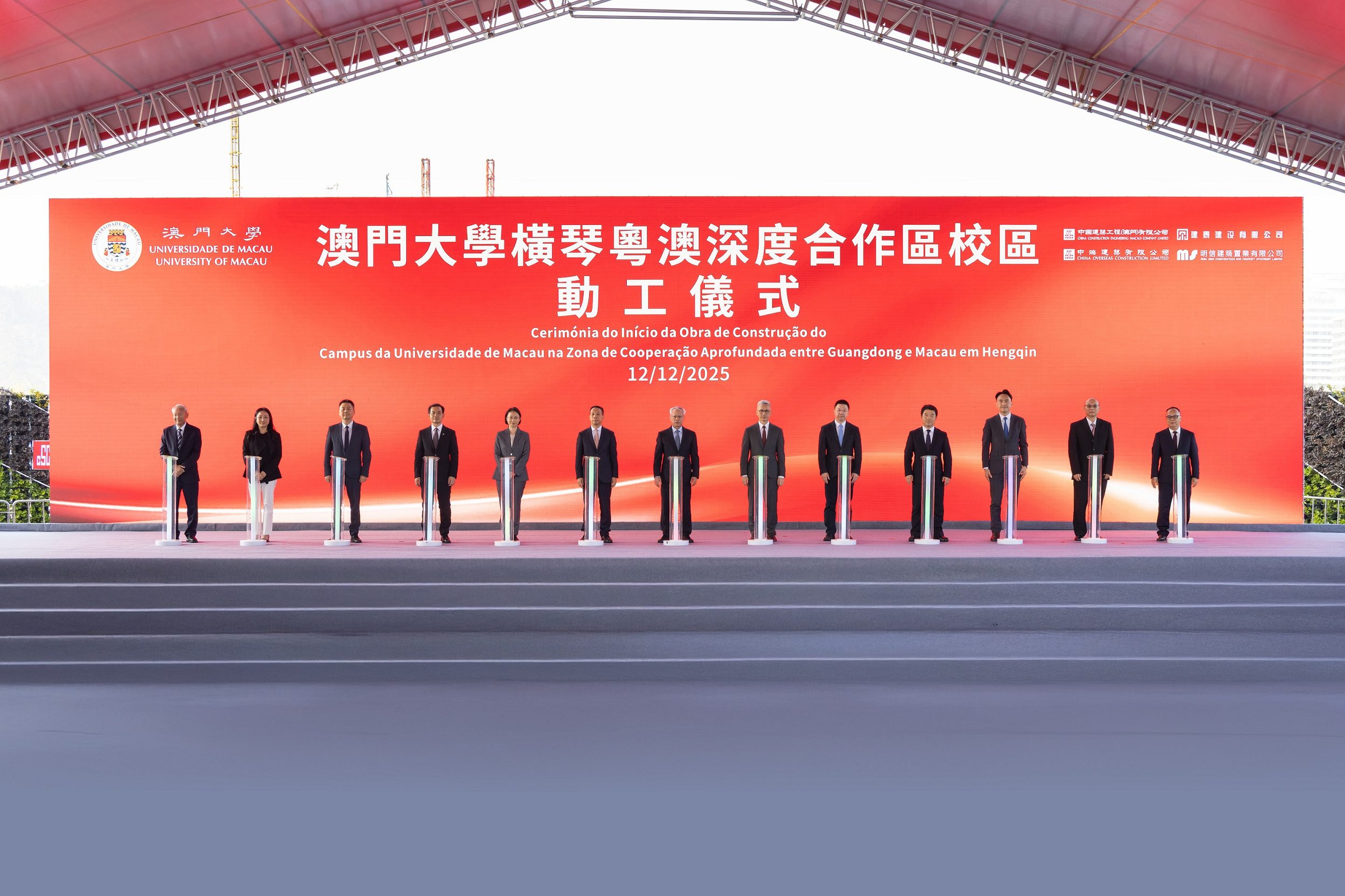
嘉賓主持澳大合作區校區動工儀式
Guests officiate at the construction commencement ceremony for UM’s campus in the Guangdong-Macao In-Depth Cooperation Zone in Hengqin
澳門大學橫琴粵澳深度合作區校區今動工
澳門大學橫琴粵澳深度合作區校區動工儀式今(12)日舉行。作為澳琴國際教育(大學)城第二期核心工程,澳大合作區校區的動工,標誌着澳琴教育一體化從“使用現有設施”向“實體建設”的關鍵跨越,是澳大開啟高質量發展新篇章、邁向澳琴全面深度融合的重要時刻,為“一國兩制”框架下澳門高等院校跨境延伸辦學、服務國家高水平科技自立自強踏出堅實一步,更為澳琴打造成為國際高端人才集聚高地注入核心動力。
動工儀式下午四時在位於橫琴粵澳深度合作區西南部的澳大合作區校區地塊舉行。澳門特別行政區行政長官岑浩輝,中央人民政府駐澳門特別行政區聯絡辦公室副主任黃柳權,橫琴粵澳深度合作區執行委員會主任戴建業,澳門特別行政區社會文化司司長柯嵐,教育部國際司副司長陳大立,橫琴粵澳深度合作區執行委員會副主任聶新平,廣東省教育廳總督學徐仕敏,橫琴粵澳深度合作區執行委員會副主任張國基,澳門教育及青年發展局局長龔志明,橫琴粵澳深度合作區民生事務局局長馮方丹、城市規劃和建設局局長劉榕及澳門大學校董會主席林金城、校長宋永華等嘉賓出席主禮,他們按下啟動按鈕,宣告工程正式展開。出席儀式的還有澳門高校及社會各界代表,共同見證這一承載教育融合使命的歷史性時刻。
宋永華在致辭中指出,澳大作為澳琴國際教育(大學)城的先行項目,率先在合作區延伸辦學並建設校區。合作區校區預計於2029年全面建成,將設立醫學院、信息學院、工學院及設計學院四個學院,並打造學科融合的創新科研平台。強調澳大未來將肩負四大使命:一是系統謀劃跨境“雙校區”一體化發展,將校區建設納入大學新一輪五年規劃,構建學科交叉融合、體系綜合均衡、科研育人協同的格局;二是充分激活科研創新動力,依託科研平台吸引國際科創要素及資源,深化大灣區產學研合作,服務國家高水平科技自立自強;三是構建國際高端人才高地,以“國際化辦學、國際化學生、國際化師資團隊、國際化學術活動”為抓手引智聚才;四是服務澳琴一體化,通過“大學 — 產業 — 城市”模式助力澳門經濟適度多元發展。
澳大合作區校區項目出讓總用地面積約37.56萬平方米,建築面積約83.1萬平方米,施工期為三年,計劃於 2028 年部分啟用,2029 年全面建成。校區規劃建設中央教學樓、體育館、濱河國際交流中心、師生宿舍等完善配套。建築設計兼具文化特色與功能價值:明朗現代的多功能綜合樓為校園標誌性建築,暗紅色調的中央教學樓彰顯人文底蘊,設計學院則以流線型空間營造藝術氛圍。各主要建築通過校園學術連廊連接,形成景觀與功能融合的空間佈局,延續澳大環境育人的理念。
欲瀏覽官網版可登入以下連結:
https://www.um.edu.mo/zh-hant/news-and-press-releases/press-release/detail/62849/
Construction commences on UM campus in Guangdong-Macao In-Depth Cooperation Zone in Hengqin
The Ceremony for the Commencement of Construction of the University of Macau’s Campus in the Guangdong-Macao In-Depth Cooperation Zone in Hengqin was held today (12 December). As the flagship project of the second phase of the Macao-Hengqin International Education (University) Town, the construction commencement represents a significant transition from ‘relying on existing facilities’ to ‘establishing a permanent physical presence’, further advancing educational integration between Macao and Hengqin. This milestone signifies a new stage of high-quality development for UM and supports deeper Macao-Hengqin integration. It also reflects meaningful progress for Macao’s higher education sector in delivering cross-border education under the ‘one country, two systems’ policy. In addition, the project is expected to contribute to China’s pursuit of scientific and technological self‑reliance and strengthen efforts to develop Macao and Hengqin into a hub for top international talent.
The construction commencement ceremony took place at 4:00pm on the campus site in the southwest of the Guangdong-Macao In-Depth Cooperation Zone in Hengqin. Officiating guests included Sam Hou Fai, chief executive of the Macao SAR; Huang Liuquan, deputy director of the Liaison Office of the Central People’s Government in the Macao SAR; Tai Kin Ip, director of the Executive Committee of the Cooperation Zone; O Lam, secretary for Social Affairs and Culture of the Macao SAR; Chan Dali, deputy director general of the Department of International Cooperation and Exchanges of the Ministry of Education; Nie Xinping, deputy director of the Executive Committee of the Cooperation Zone; Xu Shimin, deputy director general of the Department of Education of Guangdong Province; Cheong Kok Kei, deputy director of the Executive Committee of the Cooperation Zone; Kong Chi Meng, director of the Macao Education and Youth Development Bureau; Feng Fangdan, director of the Livelihood Affairs Bureau of the Cooperation Zone; Lao Iong, director of the Urban Planning and Construction Bureau of the Cooperation Zone; Lam Kam Seng Peter, chair of the University Council of UM; and Yonghua Song, rector of UM. Together, they pressed the start button to officially launch the construction. Representatives from other Macao higher education institutions and various community sectors also attended the ceremony, witnessing this historic moment in advancing educational integration.
In his speech, Song highlighted that UM has taken the lead in offering education and establishing a campus—a flagship project of the Macao-Hengqin International Education (University) Town—in the Cooperation Zone. The new campus, expected to be completed in 2029, will house the Faculty of Medicine, the Faculty of Information Science and Computing, the Faculty of Engineering, and the Faculty of Design. UM will also build an innovative, multidisciplinary research platform on the new campus to support future development. Song outlined UM’s commitment to four key missions for the future. First, the university will take a systematic approach to integrating its two cross‑border campuses, incorporating the development of the new campus into its next five‑year plan to establish an educational framework that is balanced, interdisciplinary, research‑driven, and collaborative. Second, UM aims to further strengthen its research and innovation capabilities. By leveraging its research platforms, the university will deepen industry-academia collaboration in the Greater Bay Area and support the national goal of achieving high‑level scientific and technological self‑reliance. Third, the university seeks to develop into a hub for top international talent through international education, international student recruitment, international faculty teams, and international academic activities. Fourth, through a ‘university‑industry‑city’ model, UM will support the integration of Macao and Hengqin and contribute to the diversification of Macao’s economy.
The UM campus in the Cooperation Zone covers a land area of approximately 375,600 square metres, with a total gross floor area of 831,000 square metres. Construction is expected to take about three years, with a partial opening planned for 2028 and full completion in 2029. The campus will include a central teaching building, a sports complex, a riverside international exchange centre, and residential facilities for students and staff, along with a range of supporting facilities. The architectural design will blend cultural heritage with functionality. The multi-purpose complex will stand as a bright, modern landmark; the central teaching building will be distinguished by a dark‑red façade that reflects the university’s humanistic traditions; and the Faculty of Design will incorporate streamlined spaces to create an artistic atmosphere. All major buildings will be connected by corridors, forming a cohesive layout that integrates landscape and function and reflects UM’s philosophy of nurturing students through their environment.
To read the news on UM’s official website, please visit the following link:
https://www.um.edu.mo/news-and-press-releases/press-release/detail/62849/